Hansel and Gretel · Germany, 1812
The famine in Hansel and Gretel was added in 1857
The internet says the tale is a memory of the Great Famine of 1315. The Grimms' own editions say the famine went in last, and the mother went out.
I
What the Grimms said about where it came from
The oldest text of Hansel and Gretel that exists is the one the Brothers Grimm printed in Berlin in 1812, as tale 15 of the first volume of Kinder- und Haus-Märchen.1 Nobody wrote it down before them. When the Grimms published their notes on the tales in 1856, they said exactly where they had it from:
15. Hänsel und Gretel. Nach verschiedenen Erzählungen aus Hessen. "15. Hansel and Gretel. From various tellings out of Hesse."2
They also named the story's older relatives, and neither of them is a famine. One is Italian, from Giambattista Basile's Pentamerone of the 1630s; the other is French, from Madame d'Aulnoy's "Finette Cendron" of 1697, in which abandoned children scatter a trail and pigeons eat it.2 The Grimms traced the tale to a storyteller's mouth and two seventeenth-century books. They did not trace it to 1315.
II
The mother who sends them away
Here is the 1812 opening, in the Grimms' first printing:
Vor einem großen Walde wohnte ein armer Holzhacker, der hatte nichts zu beißen und zu brechen, und kaum das tägliche Brod für seine Frau und seine zwei Kinder, Hänsel und Gretel. "Beside a great forest there lived a poor woodcutter who had nothing to bite or to break, and barely the daily bread for his wife and his two children, Hansel and Gretel."3
Poor, yes. A famine, no. And the person who proposes the abandonment is not a stepmother. When the children lie awake with hunger, the text says they "had heard everything that the mother had said to the father":
Die zwei Kinder waren auch noch wach von Hunger, und hatten alles gehört, was die Mutter zum Vater gesagt hatte.3
The word Mutter, mother, runs through the whole 1812 text. She wakes them, she leads them into the wood, she pretends to be glad when they come home and is secretly angry.3 The word Stiefmutter, stepmother, does not appear once in 1812, and not once in the 1819 second edition either.4
III
Watching an editor change a mother into a stepmother
It happens in the fourth edition, in 1840. The same sentence that read "what the mother had said to the father" now reads "what the stepmother had said to the father":
… und hatten mit angehört was die Stiefmutter zum Vater gesagt hatte.5
Wilhelm Grimm, who revised the tales edition by edition, did the change halfway. The folklorist D. L. Ashliman counts that even the final 1857 text calls her stepmother once, mother twice, and "the woman" about a dozen times.6 The seam is still visible in the version children read today.
IV
The famine that was added last
The sentence the internet quotes as proof that the tale remembers a medieval famine is this one:
Er hatte wenig zu beißen und zu brechen, und einmal, als große Theuerung ins Land kam, konnte er auch das täglich Brot nicht mehr schaffen. "He had little to bite or to break, and once, when a great dearth came over the land, he could no longer provide even the daily bread."7
It is from the seventh edition, 1857. Search the 1812, 1819 and 1840 texts for the word Theuerung, dearth, and it is not there.345 The famine entered the story forty-five years after it was first printed, as a device to make the parents' decision bearable. A famine did not produce the tale. An editor put a famine into it.
V
What the medieval records actually say
There was a Great Famine in northern Europe from 1315 to 1317, and contemporary chroniclers did write about it. Johannes de Trokelowe, a monk at St Albans in England, recorded prices and hunger, and then this:
"And, according to many reports, men and women in many places secretly ate their own children."8
Read the hedge. According to many reports. A chronicler passing on rumour is not a record that "confirms" cannibalism, and this one is English. The popular claim that records confirm cannibalism "across Germany" points at the one country for which no quotable chronicle passage could be found for this article. The theory that Hansel and Gretel began as a famine memory circulates on popular sites and is not endorsed by the Grimms' own note or by the tale scholars we could check.9 It can be told as a popular theory. It cannot be told as history.
Notes
-
Jacob and Wilhelm Grimm, Kinder- und Haus-Märchen, vol. 1, 1st ed. (Berlin: Realschulbuchhandlung, 1812), no. 15, "Hänsel und Gretel," 49–58, German Wikisource, https://de.wikisource.org/wiki/H%C3%A4nsel_und_Gretel_(1812). ↩
-
Jacob and Wilhelm Grimm, Kinder- und Haus-Märchen, vol. 3, 3rd ed. (Göttingen: Dieterich, 1856), Anmerkungen, no. 15, German Wikisource, https://de.wikisource.org/wiki/Kinder-und_Haus-M%C3%A4rchen_Band_3(1856)/Anmerkungen: "Nach verschiedenen Erzählungen aus Hessen. … Offenbar verwandt, zumal in der Einleitung, ist auch Nennillo und Nennella im Pentamerone (5, 8) und bei der Aulnoy der erste Theil von Finette Cendron (Nr. 11)." ↩↩
-
Grimm, Kinder- und Haus-Märchen (1812), no. 15. The mother throughout: "kam die Mutter und weckte sie"; "die Mutter stellte sich auch, als wenn sie sich freute, heimlich aber war sie bös." Pebbles: "da lagen die Kieselsteine wie neugeschlagene Batzen und schimmerten und zeigten ihnen den Weg." Bread: "Hänsel aber zerbröckelte all sein Brod und warf die Bröcklein auf den Weg." Birds: "die viel tausend Vöglein in dem Wald, die hatten sie gefunden und aufgepickt." Translations the author's. ↩↩↩↩
-
Jacob and Wilhelm Grimm, Kinder- und Haus-Märchen, vol. 1, 2nd ed. (Berlin: Reimer, 1819), no. 15, "Hänsel und Grethel," German Wikisource, https://de.wikisource.org/wiki/H%C3%A4nsel_und_Grethel_(1819). The text reads "was die Mutter zum Vater gesagt hatte"; Stiefmutter and Theuerung do not occur. ↩↩
-
Jacob and Wilhelm Grimm, Kinder- und Hausmärchen, vol. 1, 4th ed. (Göttingen: Dieterich, 1840), no. 15, "Hänsel und Grethel," German Wikisource, https://de.wikisource.org/wiki/H%C3%A4nsel_und_Grethel_(1840): "hatten mit angehört was die Stiefmutter zum Vater gesagt hatte"; also "Die Stiefmutter aber war gestorben." Theuerung does not occur. ↩↩
-
D. L. Ashliman, ed., "Hansel and Gretel," Folktexts, University of Pittsburgh, https://sites.pitt.edu/~dash/grimm015.html, translation of the 1857 text with an editorial note on the 1810 manuscript, the 1812 text and the 1840 change: "with the fourth edition (1840) the Grimms introduced the word 'stepmother.'" ↩
-
Jacob and Wilhelm Grimm, Kinder- und Hausmärchen, vol. 1, 7th ed. (Göttingen: Dieterich, 1857), no. 15, "Hänsel und Grethel," German Wikisource, https://de.wikisource.org/wiki/H%C3%A4nsel_und_Grethel_(1857). ↩
-
Johannes de Trokelowe, Annales, ed. H. T. Riley, Rolls Series 28 (London: Longmans, 1866), 92–95, trans. Brian Tierney, in the Internet Medieval Sourcebook mirror at https://home.uncg.edu/~jwjones/westernciv/readings/1315famine.html: "A quarter of wheat or beans or peas sold for twenty shillings"; "And, according to many reports, men and women in many places secretly ate their own children." ↩
-
Searches for a 1315 to 1317 chronicle describing children abandoned in woods, or a quotable German or Low Countries chronicle on cannibalism, found none. The famine-origin theory appears on popular sites and is attributed in one place to the popular writer Linda Raedisch; no statement endorsing it by Jack Zipes or Maria Tatar was found. The Cambridge Group for the History of Population and Social Structure's blog "Hansel and Gretel" (29 August 2024), https://www.campop.geog.cam.ac.uk/blog/2024/08/29/hansel-and-gretel/, discusses famine folklore without citing primary evidence for abandonment. ↩
Bibliography
Ashliman, D. L., ed. "Hansel and Gretel." Folktexts, University of Pittsburgh. https://sites.pitt.edu/~dash/grimm015.html.
Grimm, Jacob, and Wilhelm Grimm. Kinder- und Haus-Märchen. Vol. 1. 1st ed. Berlin: Realschulbuchhandlung, 1812. German Wikisource.
Grimm, Jacob, and Wilhelm Grimm. Kinder- und Haus-Märchen. Vol. 1. 2nd ed. Berlin: Reimer, 1819. German Wikisource.
Grimm, Jacob, and Wilhelm Grimm. Kinder- und Hausmärchen. Vol. 1. 4th ed. Göttingen: Dieterich, 1840. German Wikisource.
Grimm, Jacob, and Wilhelm Grimm. Kinder- und Hausmärchen. Vol. 1. 7th ed. Göttingen: Dieterich, 1857. German Wikisource.
Grimm, Jacob, and Wilhelm Grimm. Kinder- und Haus-Märchen. Vol. 3. 3rd ed. Göttingen: Dieterich, 1856. German Wikisource.
Trokelowe, Johannes de. Annales. Edited by H. T. Riley. Rolls Series 28. London: Longmans, 1866. Translated by Brian Tierney. Internet Medieval Sourcebook.
Named but not consulted
Jordan, William Chester. The Great Famine: Northern Europe in the Early Fourteenth Century. Princeton: Princeton University Press, 1996.
Lucas, Henry S. "The Great European Famine of 1315, 1316, and 1317." Speculum 5, no. 4 (1930): 343–77.
Image credits
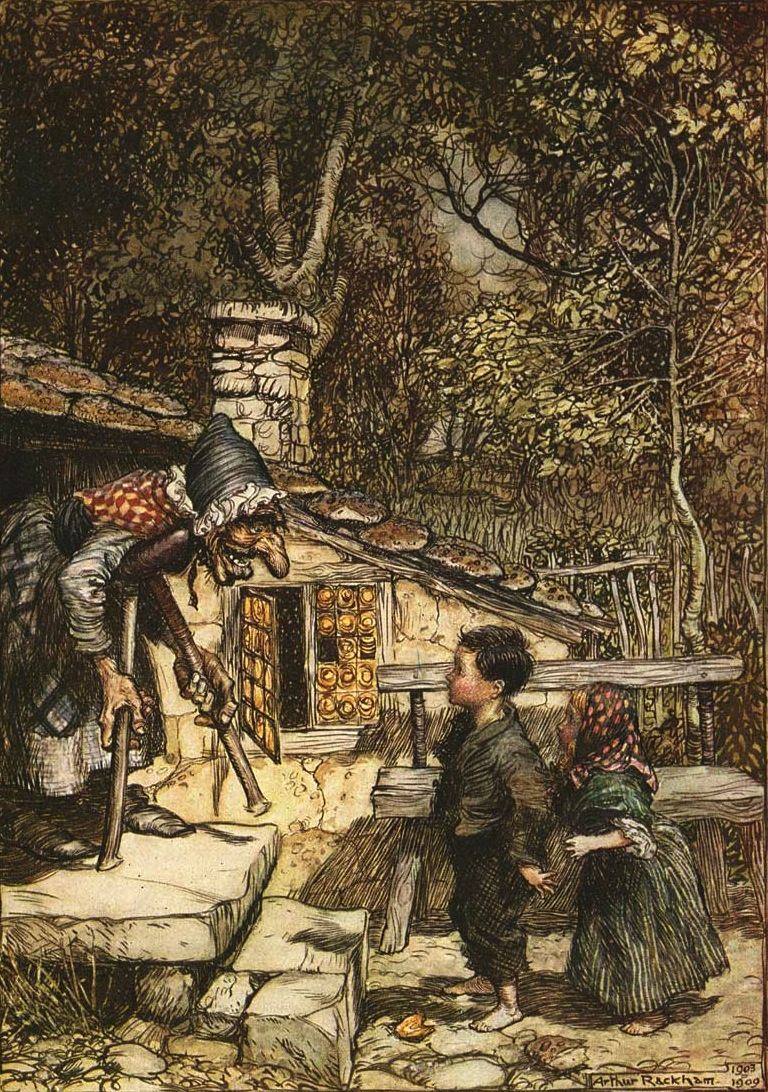
Arthur Rackham, The Fairy Tales of the Brothers Grimm, London: Constable, 1909. Public domain.
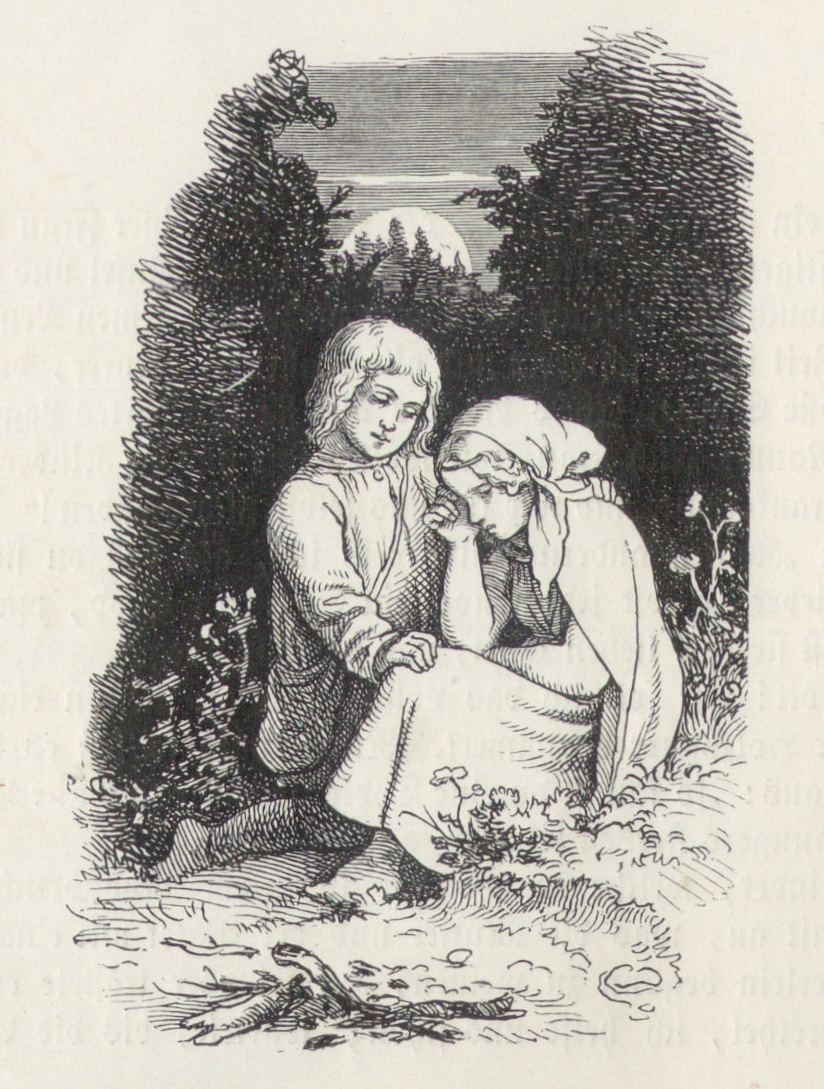
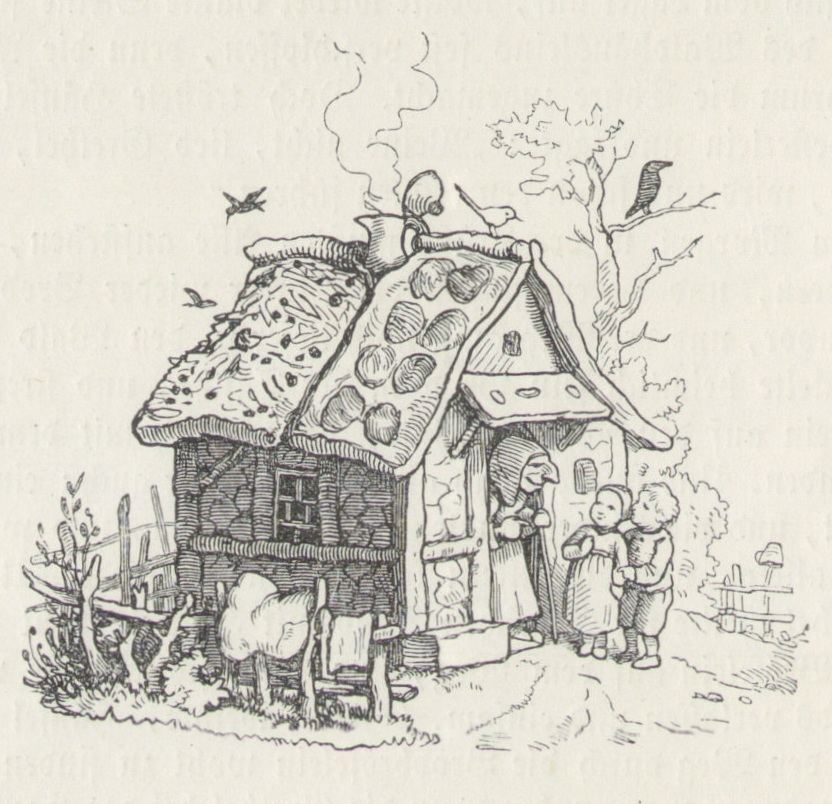
Ludwig Richter, in Ludwig Bechstein, Märchenbuch, 1853. Public domain.