The Pied Piper · Hamelin, 1284
Hamelin counted its years from the children's disappearance
The town dated its documents from the day 130 children walked out, and for almost 300 years no rat appeared in the story.
I
A town that told time by a wound
Most towns date their records from the birth of Christ. Hamelin dated its records from the day its children left.2 The Brothers Grimm preserved the detail in 1816:
"Die Bürger von Hameln haben die Begebenheit in ihr Stadtbuch einzeichnen lassen und pflegten in ihren Ausschreiben nach dem Verlust ihrer Kinder Jahr und Tag zu zahlen."
"The citizens of Hamelin had the event entered in their town book, and in their proclamations were accustomed to count the year and day from the loss of their children."8
That habit is the case's strongest evidence. A fabricated horror does not usually get written into a bureaucracy. Secondary accounts report a 1384 chronicle entry reading "It is 100 years since our children left," but I could not reach an edition of that chronicle, so treat it as reported, not verified.4
II
The oldest page
The earliest surviving account sits on the back leaves of a fifteenth-century manuscript of the Catena Aurea by the Minden Dominican Heinrich von Herford, now Lüneburg, Ratsbücherei, Theol. 2° 25, fols. 268ra to 268rb, headed Fabula exodi Hamelnsis.118 In part:
"Notandum miraculum valde rarum quod accidit in opido Hamelen Mindensis diocesis anno domini M°CC°LXXXIIII ipso die Johannis et Pauli, quidam adolescens de XXX annis pulcher et omnino bene vestitus erat. ... Et omnes pueri, fere in numero CXXX, illam festulam audientes eum sequebantur extra valvam origentalem quasi ad locum calvarie vel decollacionis."
"A most unusual wonder, which happened in the town of Hamelin in the diocese of Minden in the year of the Lord 1284, on the very day of John and Paul. A certain young man of thirty years was handsome and altogether well dressed. ... And all the children, about 130 in number, who heard that pipe, followed him out through the eastern gate, as if toward the place of Calvary or of execution."3
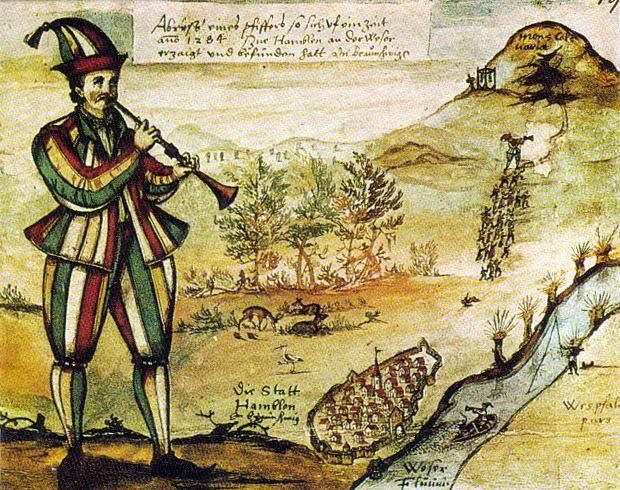
Notice what is missing. No rats, no unpaid fee, no revenge, no mountain. A well-dressed stranger of thirty, a silver pipe, an eastern gate, and a number.3 Older still may be an image: the Marktkirche's piper window, lost in the seventeenth century and surviving only as a 1592 watercolour copy.5

III
The rats arrive three centuries late
The first printed version, by Jobus Fincelius in 1556, still has no ratcatcher. It has the Devil:
"das der Teufel am tag Marie Magdalene in menschlicher gestalt sichtlich vff den gassen vmbgangen ist / hat gepfiffen / vñ viel kinder kneble vnd meidle an sich gelocket."
"that the Devil, on Mary Magdalene's day, walked visibly through the streets in human form, piped, and lured many children, little boys and little girls, to himself."19
Fincelius puts it "about 180 years" before 1556, roughly 1376, not 1284.19 The rats enter with Froben Christoph von Zimmern's Zimmerische Chronik, written between about 1559 and 1565, which supplies the unpaid fee and the revenge.11 Johann Weyer repeats the tale in De praestigiis daemonum in the 1560s.12 Two separate stories, a children's exodus and a rat expulsion, were welded together late.13 And Hamelin's medieval council books record no ratcatcher ever promised or paid.13

IV
The plaque, the street, and the quiet
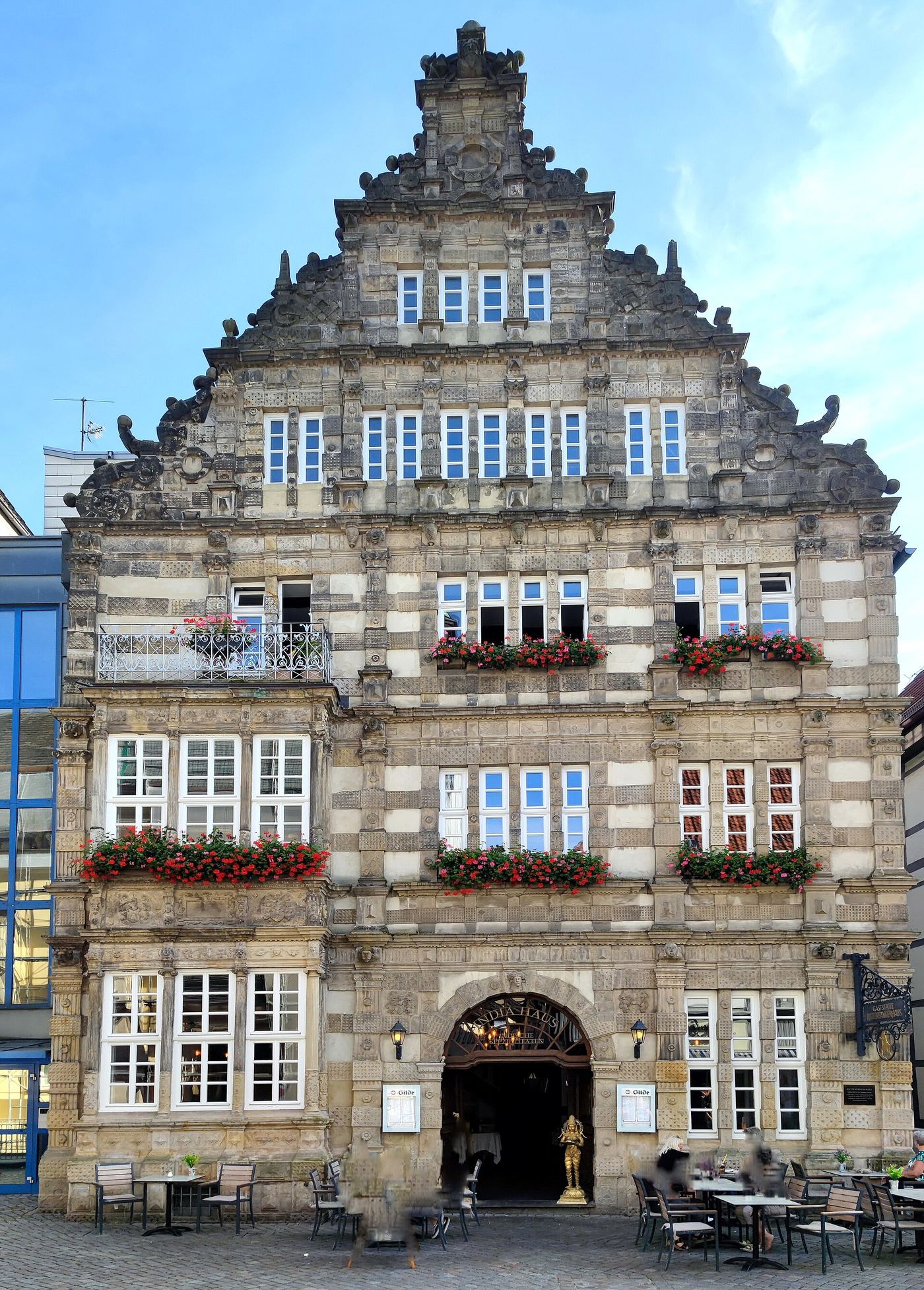
The inscription everyone photographs is real, and it is not on the town hall. It runs along a beam on the Bungelosenstrasse side of a house built in 1602/03 for the councillor Hermann Arendes, called the Rattenfängerhaus only since about 1900.7 It reads:
"ANNO 1284 AM DAGE JOHANNIS ET PAULI WAR DER 26. JUNI - DORCH EINEN PIPER MIT ALLERLEY FARVE BEKLEDET GEWESEN CXXX KINDER VERLEDET BINNEN HAMELN GEBOREN - TO CALVARIE BI DEN KOPPEN VERLOREN"
"In the year 1284 on the day of John and Paul, which was 26 June, 130 children born in Hamelin were led away by a piper clothed in all kinds of colours, lost at Calvary near the Koppen."6
The Grimms report a separate rhyme that once stood on the town hall, so that claim is not invented, only misplaced.8 As for the silence, the street is named for it. Grimm calls it "die bunge-lose (trommel-tonlose, stille), weil kein Tanz darin geschehen, noch Saiten-Spiel durfte gerührt werden," the "drumless, soundless, quiet street, because no dancing might take place there, nor stringed music be struck up."8 Verstegan said the same in 1628, and Wanley later wrote that a bride must pass in silence.910 That is attested custom, not, in anything I could fetch, a written municipal ban.
V
Where the children went
The explanation with the most evidence is the least supernatural. In 1997 the onomastics professor Jürgen Udolph tested the eastern-settlement theory against place names, and was careful about his limits:
"Ich werde im folgenden daher keineswegs zum Sagenstoff selbst beitragen ... sondern nur zu einem Teilbereich ... gemeint ist die schon lange diskutierte Frage, wohin die Aussiedler aus dem Hamelner Raum gezogen sein könnten, vorausgesetzt, die Ostkolonisationstheorie liegt der Erzählung wirklich zugrunde."
"I shall therefore in no way contribute to the legend material itself ... but only to one part of it ... namely the long-discussed question of where the emigrants from the Hamelin region might have gone, assuming the eastern colonisation theory really does underlie the story."14
His answer pointed north-east, to Brandenburg: "ohne Frage bestehen viel sicherere Namengleichungen zwischen dem Wesergebiet und den Kolonisationsgebieten nördlich von Berlin, vor allem der Prignitz, der Uckermark," or "without question there are far more secure name-equations between the Weser region and the colonisation areas north of Berlin, above all the Prignitz and the Uckermark." Hamelspringe near Hamelin reappears as Hammelspring near Templin.14 That overturned Wolfgang Wann's Moravia thesis.15 The Children's Crusade and plague theories fail on dates: the crusade was 1212, and plague reached Europe only in 1347.17 Gernot Hüsam's pagan-sect-and-landslide theory near Coppenbrügge is a named minority view.16 The piper may have been a recruiter, and the pipe may be what a town remembers instead of promises.
Notes
-
Lüneburg, Ratsbücherei, Theol. 2° 25, fols. 268ra to 268rb, "Fabula exodi Hamelnsis," in a fifteenth-century manuscript of Heinrich von Herford, Catena Aurea; described in Irmgard Fischer, Handschriften der Ratsbücherei Lüneburg: 2. Die theologischen Handschriften: 1. Folioreihe (Wiesbaden: Harrassowitz, 1972), 47 to 48, reproduced in the Herzog August Bibliothek manuscript database, https://diglib.hab.de/?db=mss&list=ms&id=lg-rb-theol-2f-25&catalog=Fischer&image=00539. The catalogue entry gives the same incipit ("Notandum miraculum valde rarum ...") and explicit ("... vidit pueros recedentes") as the transcription in note 2. ↩
-
Latin transcription of the Lüneburg addendum as published on "Rattenfänger von Hameln," German Wikipedia, https://de.wikipedia.org/wiki/Rattenf%C3%A4nger_von_Hameln, which credits the transcription and German translation to Claudia Höflich, Matthias Götte, Maximilian Schwab, Kathrin Tittel, and Kevin von Knebel, Die Rattenfänger-Überlieferung: Unterrichtsmaterialien für das Fach Latein (Hameln: Studienseminar Hameln für das Lehramt an Gymnasien, 2023). ↩
-
English translation of the Lüneburg addendum in "The Medieval Mystery Behind the Pied Piper," Medievalists.net, July 3, 2026, https://www.medievalists.net/2026/07/medieval-mystery-pied-piper/. ↩↩
-
"It is 100 years since our children left," quoted as a 1384 Hamelin chronicle entry in "The Medieval Mystery Behind the Pied Piper," Medievalists.net, July 3, 2026, https://www.medievalists.net/2026/07/medieval-mystery-pied-piper/. I was not able to fetch a scholarly edition of the chronicle itself and therefore treat this line as reported at second hand. ↩
-
On the Marktkirche window: "Rattenfänger von Hameln," German Wikipedia, https://de.wikipedia.org/wiki/Rattenf%C3%A4nger_von_Hameln, noting that Mayor Friedrich Poppendieck had an already existing window renewed ("renouiren") in 1572 and that the design survives in a drawing of 1592; and the Wikimedia Commons file description for File:Pied piper.jpg, https://commons.wikimedia.org/wiki/File:Pied_piper.jpg, which attributes the 1592 watercolour to Augustin von Moersperg and dates the window to about 1300 to 1633. Secondary accounts differ on the year the window was lost, so no single date is asserted here. ↩
-
House inscription on the Rattenfängerhaus, quoted in "Rattenfängerhaus," German Wikipedia, https://de.wikipedia.org/wiki/Rattenf%C3%A4ngerhaus. English rendering mine, from the Middle Low German. ↩
-
"Rattenfängerhaus," German Wikipedia, https://de.wikipedia.org/wiki/Rattenf%C3%A4ngerhaus: built 1602/03 for the Hamelin councillor Hermann Arendes, standing where the Bungelosenstrasse branches off the Osterstrasse, and known as the Rattenfängerhaus only since about 1900. ↩
-
Jacob and Wilhelm Grimm, "Die Kinder zu Hameln," Deutsche Sagen (Berlin: Nicolaische Buchhandlung, 1816), no. 244, 330 to 333, text at https://de.wikisource.org/wiki/Die_Kinder_zu_Hameln. The town hall verse there reads: "Im Jahr 1284 na Christi gebort / tho Hamel worden uthgevort / hundert und dreißig Kinder dasülvest geborn / dorch einen Piper under den Köppen verlorn." English renderings mine. The tale is numbered 245 in later editions. ↩↩↩
-
Richard Verstegan, A Restitution of Decayed Intelligence in Antiquities (London: John Bill, 1628), 85 to 87, in D. L. Ashliman, ed., "The Pied Piper of Hameln and related legends from other towns," https://sites.pitt.edu/~dash/hameln.html: "it was then ordained, that from thence-foorth no Drumme, Pipe or other instrument, should be sounded in the street leading to the gate through which they passed." Verstegan dates the event to 22 July 1376. ↩
-
Nathaniel Wanley, on the street "called Burgelosestrasse," in Ashliman, "The Pied Piper of Hameln," https://sites.pitt.edu/~dash/hameln.html: "if a Bride be in that street, till she is gone out of it there is no dancing to be suffered." ↩
-
Froben Christoph von Zimmern, Zimmerische Chronik, ed. Karl August Barack, vol. 3 (Tübingen, 1869), 274 to 275, translated in Ashliman, "The Pied Piper of Hameln," https://sites.pitt.edu/~dash/hameln.html ("Coming back to the subject of rats, I must relate a miracle of God ..."), and in "The Medieval Mystery Behind the Pied Piper," Medievalists.net, https://www.medievalists.net/2026/07/medieval-mystery-pied-piper/. ↩
-
"Pied Piper of Hamelin," English Wikipedia, https://en.wikipedia.org/wiki/Pied_Piper_of_Hamelin, describing the Zimmern Chronicle as "the earliest account which mentions the plague of rats" and citing Johann Weyer, De praestigiis daemonum, as a contemporary account. German Wikipedia cites the Basel 1566 edition, 84 to 85. ↩
-
"Rattenfänger von Hameln," German Wikipedia, https://de.wikipedia.org/wiki/Rattenf%C3%A4nger_von_Hameln: "Erst 1565 lässt sich anstelle des Kinder fortlockenden Teufels das Motiv des Rattenfängers ... feststellen," and "In den mittelalterlichen Ratsbüchern der Stadt Hameln ist zum Beispiel nirgends nachweisbar, dass die Stadt einem Rattenfänger Lohn versprochen oder ausbezahlt hätte." ↩↩
-
Jürgen Udolph, "Zogen die Hamelner Aussiedler nach Mähren? Die Rattenfängersage aus namenkundlicher Sicht," Niedersächsisches Jahrbuch für Landesgeschichte 69 (1997): 125 to 183, PDF at https://adw-goe.de/fileadmin/forschungsprojekte/ortsnamen_rhein_elbe/dokumente/Publikationen_Udolph_PDF/1996-2000/196._Udolph_Zogen_die_Hamelner_Aussiedler_nach_Maehren_1997.pdf. Quotations are from the PDF's OCR text layer, with the OCR's broken word spacing restored; the name pair "Hamelspringe (westl. Bad Münder) - Hammelspring (bei Templin/Uckermark)" appears as item 7 in Udolph's summary list of transferred names. English renderings mine. ↩↩
-
Wolfgang Wann, Die Lösung der Hamelner Rattenfängersage (PhD diss., Würzburg, 1949), and Der Rattenfänger von Hameln: Hamelner Landeskinder zogen aus nach Mähren, ed. W. Scherzer (Munich, 1984), as listed in Udolph's bibliography, ibid., 183. ↩
-
Gernot Hüsam, Der Koppen-Berg der Rattenfängersage von Hameln (Coppenbrügge: Museumsverein Coppenbrügge, 1990), cited for the pagan-sect and landslide theory in "Rattenfänger von Hameln," German Wikipedia, https://de.wikipedia.org/wiki/Rattenf%C3%A4nger_von_Hameln, which calls it "eine andere, weniger stark vertretene Theorie," and in "Pied Piper of Hamelin," English Wikipedia, https://en.wikipedia.org/wiki/Pied_Piper_of_Hamelin. ↩
-
"Rattenfänger von Hameln," German Wikipedia, https://de.wikipedia.org/wiki/Rattenf%C3%A4nger_von_Hameln: the Children's Crusade took place in 1212 while the transmitted date is 1284, and plague epidemics appear in medieval Europe only from 1347. ↩
-
Museum Hameln, "The Pied Piper in Literature and Arts: The Children's Exodus," https://museumhameln.de/dauerausstellung_engl_rf09/: a verse in red ink on the title page of a missal bewailing "the 130 beloved Hamelner children" who were "eaten alive by Calvaria," described as probably the oldest written source and missing for hundreds of years. ↩
-
Jobus Fincelius, Warhafftige beschreibung und gründlich verzeichnus schrecklicher Wunderzeichen und Geschichten (Jena: Christian Rödiger, 1556), unpaginated; early New High German transcription in "Rattenfänger von Hameln," German Wikipedia, https://de.wikipedia.org/wiki/Rattenf%C3%A4nger_von_Hameln. English rendering mine. ↩↩
Bibliography
Ashliman, D. L., ed. "The Pied Piper of Hameln and Related Legends from Other Towns." Folktexts. University of Pittsburgh. https://sites.pitt.edu/~dash/hameln.html.
Browning, Robert. The Pied Piper of Hamelin. Illustrated by Kate Greenaway. London and New York: Frederick Warne, 1888. Poem first published 1842. Text in Ashliman, "The Pied Piper of Hameln."
Fincelius, Jobus. Warhafftige beschreibung und gründlich verzeichnus schrecklicher Wunderzeichen und Geschichten. Jena: Christian Rödiger, 1556.
Fischer, Irmgard. Handschriften der Ratsbücherei Lüneburg: 2. Die theologischen Handschriften: 1. Folioreihe. Wiesbaden: Harrassowitz, 1972. Description of Theol. 2° 25 consulted via the Herzog August Bibliothek manuscript database, https://diglib.hab.de/?db=mss&list=ms&id=lg-rb-theol-2f-25&catalog=Fischer&image=00539.
Grimm, Jacob, and Wilhelm Grimm. "Die Kinder zu Hameln." In Deutsche Sagen, no. 244, 330 to 333. Berlin: Nicolaische Buchhandlung, 1816. https://de.wikisource.org/wiki/Die_Kinder_zu_Hameln.
Lüneburg, Ratsbücherei, MS Theol. 2° 25, fols. 268ra to 268rb. "Fabula exodi Hamelnsis," c. 1430 to 1450, in Heinrich von Herford, Catena Aurea.
Medievalists.net. "The Medieval Mystery Behind the Pied Piper." July 3, 2026. https://www.medievalists.net/2026/07/medieval-mystery-pied-piper/.
Museum Hameln. "The Pied Piper in Literature and Arts: The Children's Exodus." https://museumhameln.de/dauerausstellung_engl_rf09/.
Udolph, Jürgen. "Zogen die Hamelner Aussiedler nach Mähren? Die Rattenfängersage aus namenkundlicher Sicht." Niedersächsisches Jahrbuch für Landesgeschichte 69 (1997): 125 to 183. https://adw-goe.de/fileadmin/forschungsprojekte/ortsnamen_rhein_elbe/dokumente/Publikationen_Udolph_PDF/1996-2000/196._Udolph_Zogen_die_Hamelner_Aussiedler_nach_Maehren_1997.pdf.
Verstegan, Richard. A Restitution of Decayed Intelligence in Antiquities. London: John Bill, 1628. Extract in Ashliman, "The Pied Piper of Hameln."
Wanley, Nathaniel. "The Pyed Piper." Extract in Ashliman, "The Pied Piper of Hameln."
Wikipedia. "Pied Piper of Hamelin." https://en.wikipedia.org/wiki/Pied_Piper_of_Hamelin.
Wikipedia. "Rattenfänger von Hameln." https://de.wikipedia.org/wiki/Rattenf%C3%A4nger_von_Hameln.
Wikipedia. "Rattenfängerhaus." https://de.wikipedia.org/wiki/Rattenf%C3%A4ngerhaus.
Zimmern, Froben Christoph von. Zimmerische Chronik. Edited by Karl August Barack. Vol. 3. Tübingen, 1869. Translation in Ashliman, "The Pied Piper of Hameln."
Named but not consulted
These works are cited by the sources above and shape the scholarship, but I did not fetch or read them, so nothing in this article rests on them directly.
- Dobbertin, Hans. Beiträge zur Hamelner Kinderausfahrt (1284). 2nd ed. Eldagsen, 1981.
- Höflich, Claudia, Matthias Götte, Maximilian Schwab, Kathrin Tittel, and Kevin von Knebel. Die Rattenfänger-Überlieferung: Unterrichtsmaterialien für das Fach Latein. Hameln: Studienseminar Hameln, 2023. (Transcription used at second hand via German Wikipedia.)
- Hüsam, Gernot. Der Koppen-Berg der Rattenfängersage von Hameln. Coppenbrügge: Museumsverein Coppenbrügge, 1990.
- Krogmann, Willy. Der Rattenfänger von Hameln: Eine Untersuchung über das Werden der Sage. Berlin: E. Ebering, 1934.
- Mieder, Wolfgang. The Pied Piper: A Handbook.
- Spanuth, Heinrich. Der Rattenfänger von Hameln: Vom Werden und Sinn einer alten Sage. Hameln: C. W. Niemeyer, 1951.
- Wann, Wolfgang. Die Lösung der Hamelner Rattenfängersage. PhD diss., Würzburg, 1949.
- Weyer, Johann. De praestigiis daemonum. Basel: Oporinus, 1566.
- Wolfers, D. "A Plaguey Piper." The Lancet 285, no. 7388 (April 1965): 756 to 757.
Image credits
Augustin von Moersperg, watercolour copy of the Marktkirche window, 1592. Public domain.
Inscription on the Rattenfängerhaus, Osterstrasse, Hamelin, 1602/03. Photograph via Wikimedia Commons. Public domain.
Kate Greenaway, in Robert Browning, The Pied Piper of Hamelin, London: Routledge, 1888. Public domain.
The Rattenfängerhaus, Hamelin. Photograph by Helmlechner, 2025, CC0.