Little Red Riding Hood · France, 1697
The peasant Red Riding Hood saved herself
In the oral French version the girl eats her grandmother without knowing it, and then she escapes on her own, with no hunter anywhere in the story.
I
What Perrault actually printed
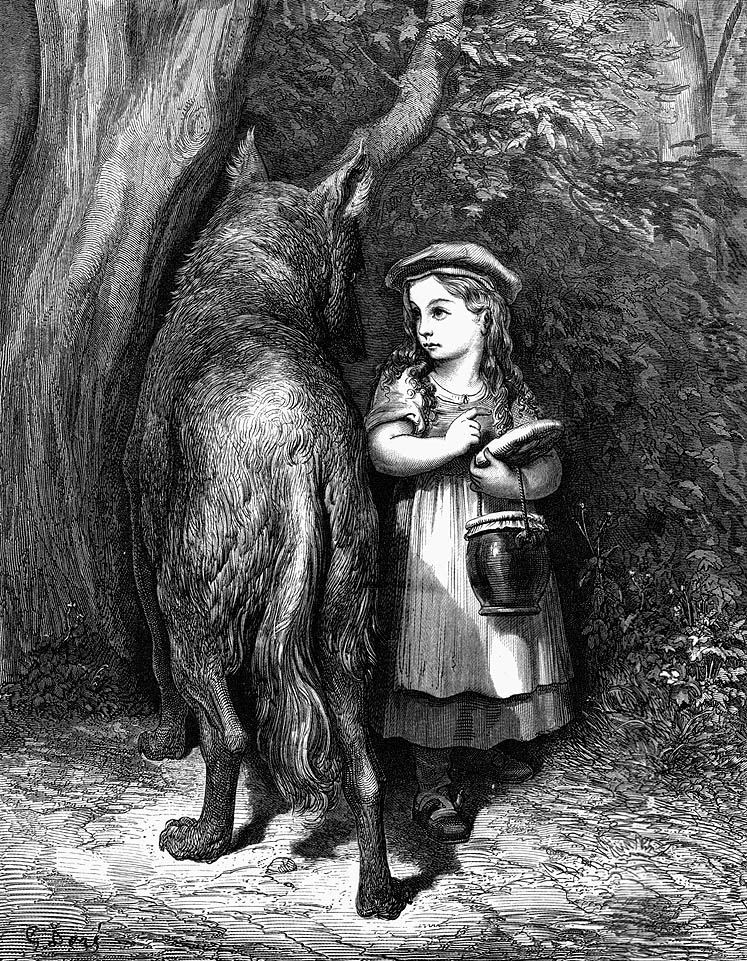
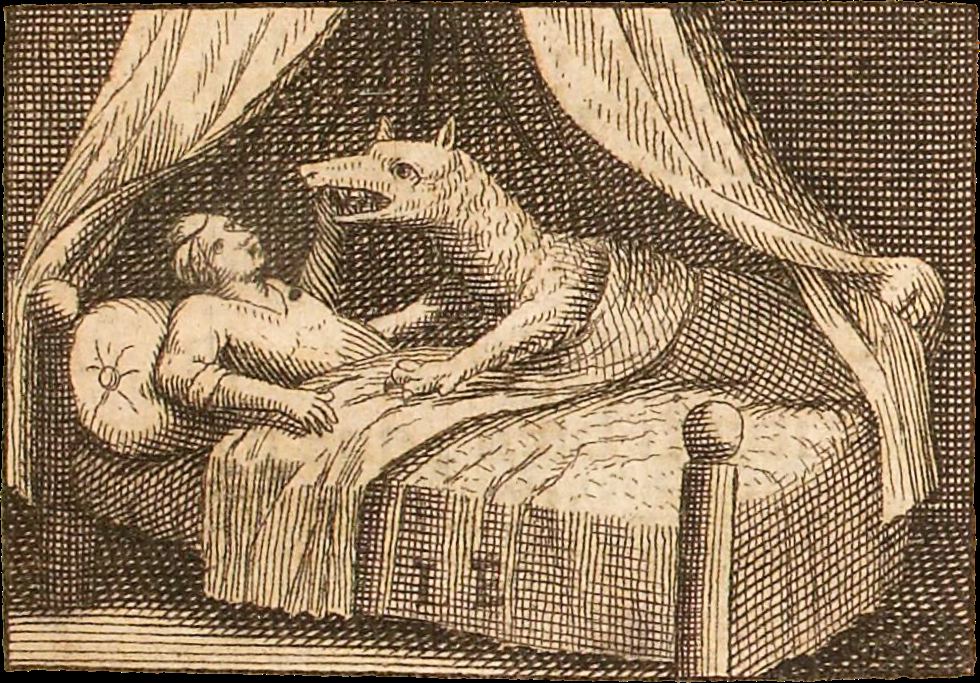
Charles Perrault's "Le petit chaperon rouge" appeared in Histoires ou contes du temps passé, avec des moralitez, printed in Paris by Claude Barbin in 1697.4 The story stops where most modern retellings begin their rescue. The last line of the tale proper reads: "Et, en disant ces mots, ce méchant loup se jetta sur le petit chaperon rouge, & la mangea." In English: "And, saying these words, this wicked wolf threw himself upon Little Red Riding Hood, and ate her."1
That is the entire ending. Nothing is cut open, nobody climbs out. Perrault ends in the dark.
There is one detail worth keeping, because it is the seed of a later mistake. Perrault does put woodcutters in his forest. The wolf "eut bien envie de la manger, mais il n'osa, à cause de quelques bucherons qui estoient dans la Forest," that is, he badly wanted to eat her but did not dare, because of some woodcutters who were in the forest.3 They are the reason the wolf waits. They never come back. Perrault's woodcutters are a delay, not a rescue.
II
The moral says the wolf is a man
Perrault then adds a verse MORALITÉ, and it is startlingly direct about who the tale is for. "On voit icy que de jeunes enfans, / Sur tout de jeunes filles, / Belles, bien faites & gentilles, / Font tres-mal d'écouter toute sorte de gens." In English: "We see here that young children, above all young girls, beautiful, well made and nice, do very badly to listen to all sorts of people." He goes on: not all wolves are the same kind, and some are "d'une humeur accorte, / Sans bruit, sans fiel & sans courroux," pleasant, quiet, without bile or anger, who follow young ladies into houses and down side streets. "Mais, hélas! qui ne sçait que ces loups doucereux, / De tous les loups sont les plus dangereux," but alas, who does not know that these sweet-talking wolves are the most dangerous wolves of all.2
The predator hiding in plain sight is Perrault's own idea, printed in 1697, in verse, under the story.
III
The Grimms sent a huntsman, not a woodsman
In the first edition of the Kinder- und Haus-Märchen (Berlin, 1812), tale number 26, "Rothkäppchen," the rescuer arrives like this: "Der Jäger ging eben vorbei und gedacht, wie kann die alte Frau so schnarchen, du mußt einmal nachsehen." That is: "The huntsman was just going past and thought, how can the old woman snore like that, you had better take a look."5 Jäger means hunter. He carries scissors and cuts the wolf open. He is not a woodsman and he carries no axe; the axe belongs to later illustrators.
The 1812 text also runs a second episode after the happy ending, which almost nobody retells. A different wolf comes back, grandmother has Rothkäppchen fill a stone trough with the water the sausages were boiled in, the smell pulls the wolf off the roof, "er fing an zu rutschen, und rutschte vom Dach herab und gerade in den großen Trog hinein und ertrank," he began to slide, slid down off the roof straight into the big trough, and drowned.6 Two women kill a wolf with sausage water, unaided.
The Grimms also left a note in their own appendix admitting they had found this tale nowhere except in their oral source and in Perrault: "Dieses Märchen haben wir außer unserer mündlichen Sage, was zu wundern ist, nirgends angetroffen, als bei Perrault."7
IV
The peasant version, and what it actually ends with
The oral French tale is titled "Conte de la mère-grand." The Bibliothèque nationale de France prints it from the papers of the folklorist Achille Millien, collected in the Nivernais, and published by Paul Delarue.8 It is much worse than Perrault, until the last page.
The wolf is a bzou, a werewolf. He kills the grandmother, "mit de sa viande dans l'arche et une bouteille de sang sur la bassie," put some of her meat in the chest and a bottle of her blood on the shelf, and then tells the girl to help herself. A cat says it out loud: "Pue!... Salope!... qui mange la chair, qui boit le sang de sa grand," roughly, "Filthy girl, eating her grandmother's flesh, drinking her grandmother's blood." Then the undressing, garment by garment: "Où faut-il mettre mon tablier?" "Jette-le au feu, mon enfant, tu n'en as plus besoin." "Where should I put my apron?" "Throw it in the fire, my child, you won't need it anymore."8
And then the part the retellings delete. In bed, she says she needs to go outside to relieve herself. The bzou ties a woollen thread to her foot and lets her out. She ties the thread to a plum tree and runs. "Il la poursuivit, mais il arriva à sa maison juste au moment où elle entrait." He chased her, but he reached her house just as she was going inside.8 She gets home. No hunter, no woodsman, no rescue, because she does not need one.9
V
Older, probably, but not proven older
The internet calls this the version from "before" Perrault. Scholars do argue that the oral versions owe nothing to print, and Yvonne Verdier writes that they were gathered mostly at the end of the nineteenth century, from the storytellers' own mouths, in the Loire basin, the Nivernais, the Forez and the Velay.10 But the recording is late. The BnF dates Millien's text to around 1870, roughly 170 years after Perrault went to press.8 "Older" here is an inference from the tale's shape, not a dated manuscript.
The audience claim needs the same care. Delarue and Marc Soriano read the tale flatly, as "un conte d'avertissement," a warning tale for the guidance of children, with Delarue insisting the wolf is a real wolf of flesh and bone, the kind that "effectivement enlevé et dévoré tant d'enfants," actually carried off and devoured so many children.11 Jack Zipes reads the oral tale in the opposite direction, as a story that "celebrates the self-reliance of a young peasant girl."12 Both are interpretation. What is documented is the text, and the text lets her go.
Notes
-
Charles Perrault, "Le petit chaperon rouge," in Histoires ou contes du temps passé, avec des moralitez (Paris: Claude Barbin, 1697), 65, transcribed from the Gallica scan (BnF ark bpt6k10545223) on French Wikisource, https://fr.wikisource.org/wiki/Page:Perrault_-_Histoires_ou_contes_du_temps_pass%C3%A9,_avec_des_moralitez,_1697.djvu/65. Fetched as page source; original 1697 orthography retained ("se jetta," "&"). Modernized editions print "se jeta sur le petit chaperon rouge, et la mangea." ↩
-
Perrault, "Le petit chaperon rouge," 66 (the verse "MORALITÉ"), https://fr.wikisource.org/wiki/Page:Perrault_-_Histoires_ou_contes_du_temps_pass%C3%A9,_avec_des_moralitez,_1697.djvu/66. ↩
-
Perrault, "Le petit chaperon rouge," 59, https://fr.wikisource.org/wiki/Page:Perrault_-_Histoires_ou_contes_du_temps_pass%C3%A9,_avec_des_moralitez,_1697.djvu/59. ↩
-
Imprint details (Auteur: Charles Perrault; Éditeur: Claude Barbin; Lieu: Paris; Annee: 1697; BNF_ARK: bpt6k10545223) from the Wikisource index record for the scanned 1697 edition, https://fr.wikisource.org/wiki/Livre:Perrault_-_Histoires_ou_contes_du_temps_pass%C3%A9,_avec_des_moralitez,_1697.djvu. ↩
-
Jacob and Wilhelm Grimm, "Rothkäppchen," no. 26, in Kinder- und Haus-Märchen, 1st ed. (Berlin: Realschulbuchhandlung, 1812), 1:116, transcribed on German Wikisource, https://de.wikisource.org/wiki/Rothk%C3%A4ppchen_(1812). ↩
-
Grimm, "Rothkäppchen" (1812), 1:117-18, same URL as note 5. ↩
-
Grimms' appendix note, "Zum Rothkäppchen. No. 26," Kinder- und Haus-Märchen, 1st ed. (1812), 1:XXII, reproduced at the foot of the Wikisource page cited in note 5. ↩
-
"Le Conte de la mère-grand," attributed on the page to "Achille Millien, Le Conte de la mère-grand, 1870," with the editorial note that it is a variant of Le Petit Chaperon rouge collected by the folklorist Achille Millien (1838-1927) in the Nivernais "autour des années 1870" and published by Paul Delarue in Le Conte populaire français (Paris: Maisonneuve et Larose, 1957-1985). BnF Essentiels, Bibliothèque nationale de France, https://essentiels.bnf.fr/fr/extrait/aa504272-8e1b-4a92-8a22-5cba73826c24-conte-la-mere-grand. Note on dating: the brief for this article gave "c. 1885"; the BnF page, which is the source actually fetched, says around 1870, as does the Ashliman page in note 9. The article follows the fetched sources. ↩↩↩↩
-
D. L. Ashliman, trans., "The Grandmother," in "Little Red Riding Hood and other tales of Aarne-Thompson-Uther type 333," University of Pittsburgh, https://sites.pitt.edu/~dash/type0333.html. Ashliman's source line reads: "Conte de la mère-grand, from a website sponsored by the Bibliothèque nationale de France... Collected by folklorist Achille Millien (1838-1927) in the French province of Nivernais, about 1870." The same page supplied the Grimm and Perrault English texts consulted for comparison. ↩
-
Yvonne Verdier, Le Petit Chaperon rouge dans la tradition orale (Paris: Éditions Allia, 2024), publisher's PDF extract, 7-9, https://www.editions-allia.com/files/pdf_629_file.pdf. Verdier's footnote there gives the full reference for Delarue's survey: P. Delarue, "Les contes merveilleux de Perrault et la tradition populaire: i. Le Petit Chaperon rouge," Bulletin folklorique d'Île-de-France (Paris, 1951), 221-28, 251-60, 283-91; and 1953, 511-17. The Delarue article itself was not fetched and is listed below as consulted only at second hand. ↩
-
Verdier, Le Petit Chaperon rouge dans la tradition orale, extract, 12-14, same URL as note 10. Verdier is quoting and disputing P. Delarue, Le Conte populaire français, and M. Soriano, Les Contes de Perrault; the phrases "conte d'avertissement" and "effectivement enlevé et dévoré tant d'enfants" appear in her text as quotations from Delarue. ↩
-
University of Minnesota Libraries, "Little Red Riding Hood: Modeling a Comparative Folklore Study," online exhibit, https://gallery.lib.umn.edu/exhibits/show/lrrh/lit-review, quoting Jack Zipes, The Trials and Tribulations of Little Red Riding Hood (South Hadley, MA: Bergin and Garvey, 1983), 8. Zipes's book was not fetched; this is a quotation at second hand from a university library exhibit, and is labeled as such. ↩
Bibliography
Ashliman, D. L., trans. "Little Red Riding Hood and Other Tales of Aarne-Thompson-Uther Type 333." University of Pittsburgh. https://sites.pitt.edu/~dash/type0333.html.
Bibliothèque nationale de France. "Le Conte de la mère-grand." BnF Essentiels. https://essentiels.bnf.fr/fr/extrait/aa504272-8e1b-4a92-8a22-5cba73826c24-conte-la-mere-grand.
Grimm, Jacob, and Wilhelm Grimm. "Rothkäppchen." No. 26 in Kinder- und Haus-Märchen. 1st ed. Vol. 1. Berlin: Realschulbuchhandlung, 1812. https://de.wikisource.org/wiki/Rothk%C3%A4ppchen_(1812).
Perrault, Charles. "Le petit chaperon rouge." In Histoires ou contes du temps passé, avec des moralitez. Paris: Claude Barbin, 1697. https://fr.wikisource.org/wiki/Livre:Perrault_-_Histoires_ou_contes_du_temps_pass%C3%A9,_avec_des_moralitez,_1697.djvu.
University of Minnesota Libraries. "Little Red Riding Hood: Modeling a Comparative Folklore Study." Online exhibit. https://gallery.lib.umn.edu/exhibits/show/lrrh/lit-review.
Verdier, Yvonne. Le Petit Chaperon rouge dans la tradition orale. Paris: Éditions Allia, 2024. Publisher's PDF extract. https://www.editions-allia.com/files/pdf_629_file.pdf.
Named but not consulted
These were named in the brief or turned up in the research, but their texts were not fetched, so nothing in the article rests on them directly.
- Delarue, Paul. "Les contes merveilleux de Perrault et la tradition populaire: i. Le Petit Chaperon rouge." Bulletin folklorique d'Île-de-France, 1951, 221-28, 251-60, 283-91; 1953, 511-17. Citation taken from Verdier's footnote (note 10).
- Delarue, Paul. The Borzoi Book of French Folk Tales. New York: Knopf, 1956. Existence and date confirmed only from the Internet Archive catalog record (identifier borzoibookoffren00dela); the text is lending-restricted and was not read.
- Delarue, Paul. Le Conte populaire français. Paris: Maisonneuve et Larose, 1957-1985. Known only through the BnF page and Verdier's citations.
- Dundes, Alan, ed. Little Red Riding Hood: A Casebook. Madison: University of Wisconsin Press, 1989.
- Orenstein, Catherine. Little Red Riding Hood Uncloaked: Sex, Morality, and the Evolution of a Fairy Tale. New York: Basic Books, 2002. Existence and date confirmed from the Internet Archive catalog record; no passage was fetchable, so the article makes no claim on her authority.
- Soriano, Marc. Les Contes de Perrault. Paris: Gallimard, 1977. Known only through Verdier's quotations.
- Zipes, Jack. The Trials and Tribulations of Little Red Riding Hood. South Hadley, MA: Bergin and Garvey, 1983. Quoted at second hand only, via note 12.
Image credits
Gustave Doré, Les Contes de Perrault, 1862. Public domain.
Antoine Clouzier, woodcut in Perrault, Histoires ou contes du temps passé, Paris: Barbin, 1697. Bibliothèque nationale de France via Wikimedia Commons. Public domain.
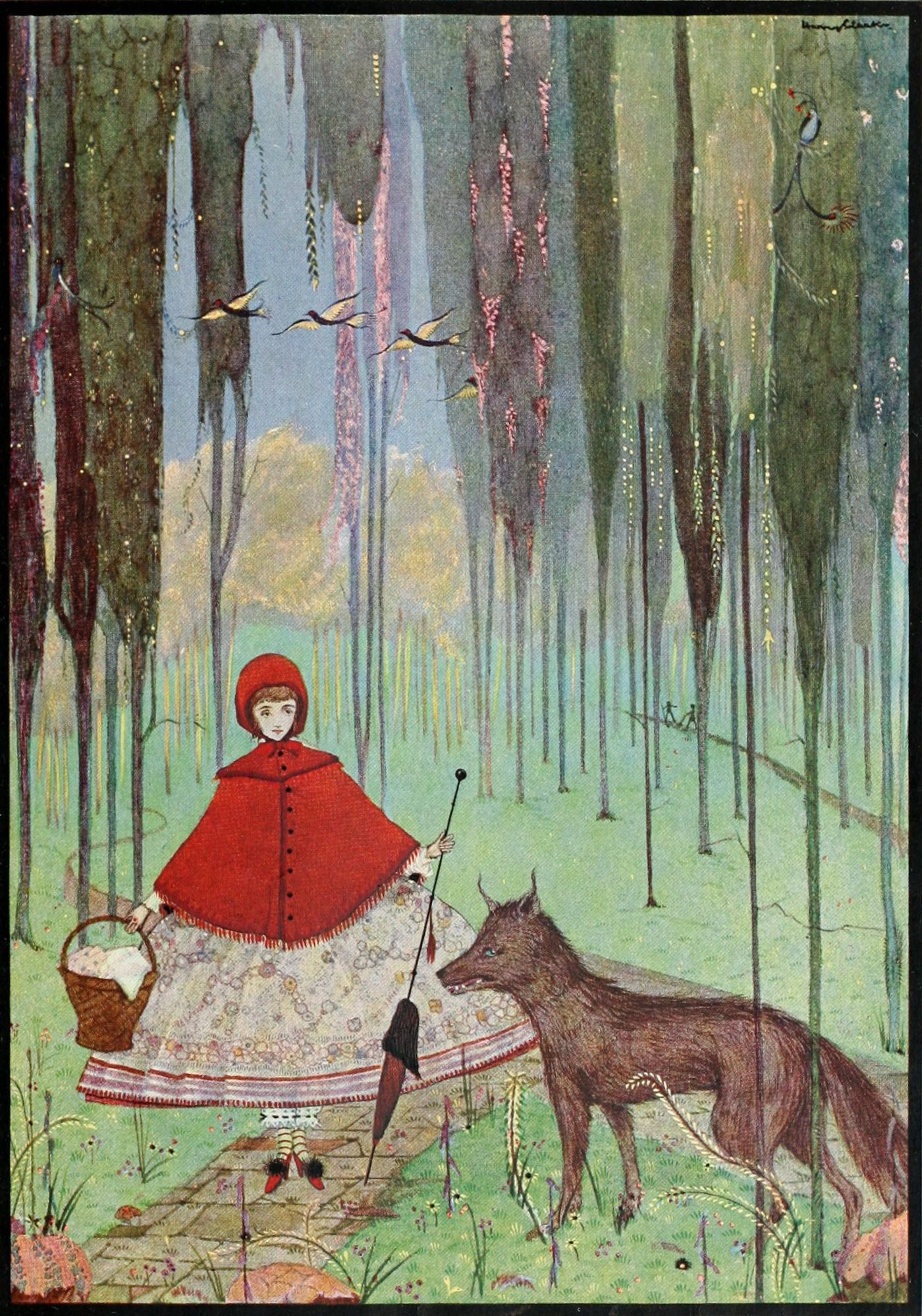
Harry Clarke, The Fairy Tales of Charles Perrault, London: Harrap, 1922. Public domain.