The Legend of the White Snake · China, 1624
In the oldest White Snake, the husband calls Fahai
In the earliest full printed version, from 1624, Bai Niangzi hands her husband stolen government silver, threatens to kill a city, and confesses she is a python, and Xu Xuan is the one who goes looking for the monk.
I
A borrowed umbrella, then fifty taels of stolen silver
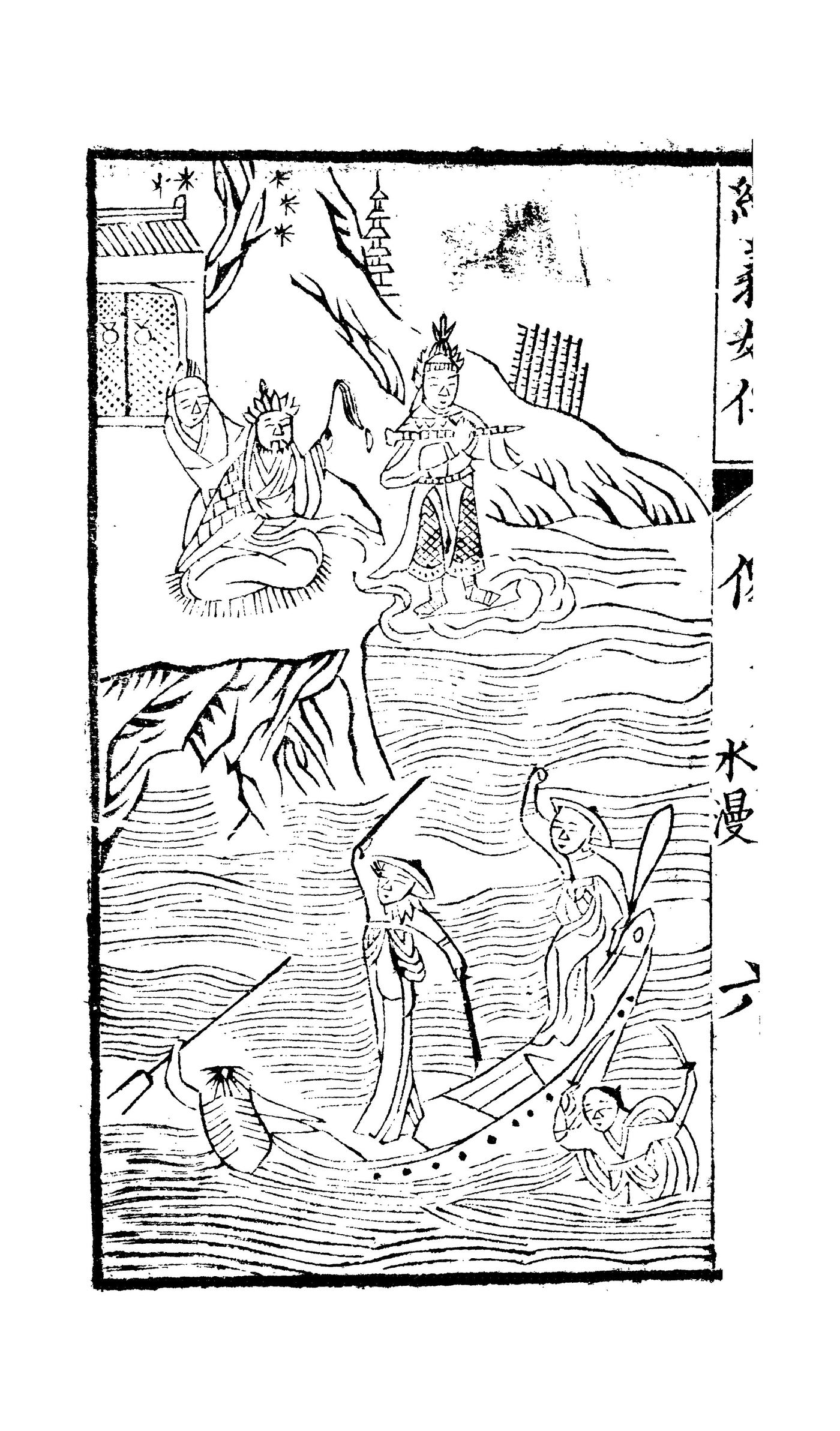
Everyone knows the opening. Rain on West Lake, a boat, a lent umbrella, a beautiful widow in white. The 1624 text keeps all of that, then does something the retellings leave out. On his second visit, before any wedding, she sends her maid upstairs for money and presses a packet into his hands: 「小乙官人,这东西将去使用,少欠时再来取。」 "Master Xu, take this and spend it; when you run short, come back for more." He opens it at home. 「却是五十两雪花银子。」 "It was fifty taels of snow-white silver."2
His brother-in-law recognizes the ingot stamps and screams. 「数日前邵太尉库内封记锁押俱不动……平空不见了五十锭大银。」 "A few days ago, in Commander Shao's treasury, the seals and locks were all untouched, yet fifty large ingots of silver vanished into thin air."3 Xu Xuan is arrested, beaten and sent to a prison camp at Suzhou. In Zhenjiang it happens again, with a pawnshop's jewels. When he next sees her he shouts: 「你这贼贱妖精!连累得我好苦,吃了两场官事!」 "You thieving, base demon! You dragged me through misery, two criminal cases!"4
II
"I am a great python"
Fahai first spots him at Jinshan Temple and sends an attendant to fetch him, who loses him in the crowd.5 At the riverbank the monk shouts 「业畜!在此做甚么?」 "Beast! What are you doing here?" and hands Xu Xuan a verse: 「本是妖精变妇人,西湖岸上卖娇声。」 "She is a demon turned into a woman, selling her sweet voice on the shore of West Lake."5
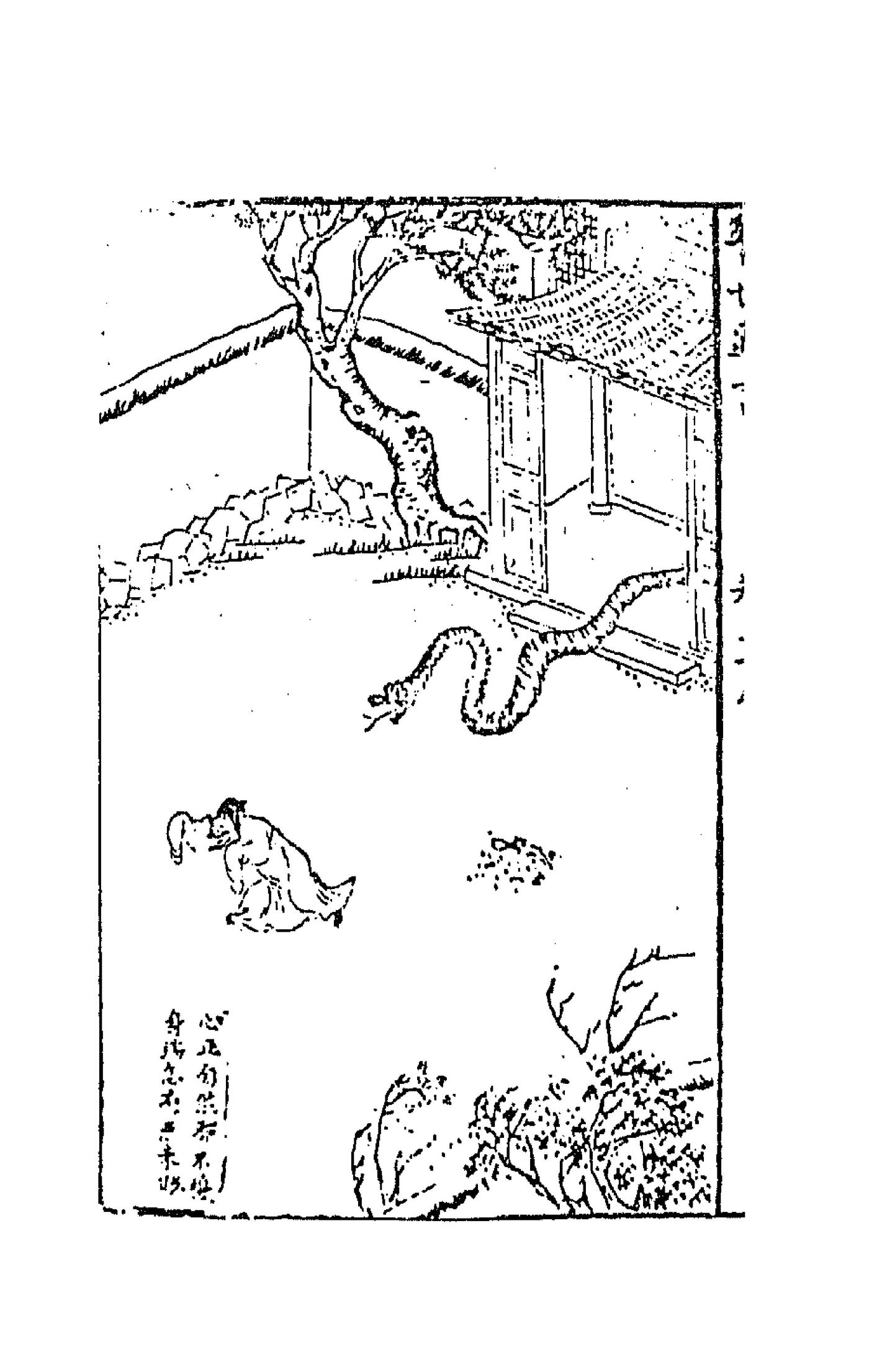
That is the monk's accusation. Hers is stronger. Trapped under the alms bowl, shrunk to a puppet's size, she volunteers it: 「禅师,我是一条大蟒蛇……不想遇着许宣,春心荡漾,按纳不住,一时冒犯天条,却不曾杀生害命。」 "Chan master, I am a great python... I did not expect to meet Xu Xuan; my spring longing stirred and I could not hold it down, and for a moment I broke the laws of Heaven. But I never killed anyone."8
She also threatens mass murder. When Xu Xuan hires a snake-catcher: 「你若和我好意,佛眼相看;若不好时,带累一城百姓受苦,都死于非命!」 "If you treat me well, I will look on you with the eye of the Buddha. If you do not, I will bring this whole city's people to grief, and every one will die an unnatural death."6
III
The husband goes looking for the monk
Here is the detail that breaks the modern reading. Fahai does not hunt her down. He tells Xu Xuan where to find him, and Xu Xuan comes. About to drown himself in West Lake, Xu Xuan remembers: 「急入寺中,问监寺道:『动问和尚,法海禅师曾来刹也未?』」 "He rushed into the temple and asked the prior, 'May I ask, has Chan Master Fahai come to this temple yet?'" When the monk appears, Xu Xuan 「纳头便拜,道:『救弟子一命则个!』」 "bowed his head to the ground and said, 'Save your disciple's life!'" Fahai gives him the alms bowl and tells him to clap it over her head himself.7
Then the husband pays for her prison: 「后来许宣化缘,砌成了七层宝塔。」 "Later Xu Xuan begged for the alms to build it up into a seven-storey treasure pagoda."9 And then he joins the order: 「惟有许宣情愿出家……就雷峰塔披剃为僧。」 "Only Xu Xuan chose of his own will to leave the world, and at Leifeng Pagoda had his head shaved and became a monk."11
IV
The story prints its own moral
Feng Menglong does not make you guess. Fahai leaves a prophecy, 「雷峰塔倒,白蛇出世。」 "When Leifeng Pagoda falls, the white snake will come out into the world,"10 then eight lines of advice: 「奉劝世人休爱色……但看许宣因爱色,带累官司惹是非。」 "I urge the people of the world to stop loving beauty... Just look at Xu Xuan, who because he loved beauty was dragged into lawsuits."11 It is a sermon against lust, aimed at men.
The older fragment is colder. In Xihu santa ji, printed in the Ming collection Qingping shantang huaben, the lady in white has men's hearts cut out at her dinner table, 「取出心肝,呈上娘娘」 "took out the heart and liver and presented them to the Lady," before being exposed as a white snake and pinned under three pagodas in the lake.12
V
The sympathy is modern. So is the algorithm.
The pagoda was never built for her. Sutra scrolls sealed inside its bricks carry Qian Chu's own dedication, 「造此經八萬四千卷入西關塼塔永充供養,乙亥八月日紀」 "had 84,000 copies of this sutra made and interred them in the brick pagoda at the West Gate as an enduring offering, noted on a day of the eighth month of the yihai year," that is 975.13 A Ming gazetteer copies out his record and then corrects its own readers: 「俗稱塔鎮青魚白蛇,讀吳越王記,知所供惟佛螺髻髮耳。」 "Common talk says the pagoda pins down a green fish and a white snake; read the King of Wuyue's record and you know what is enshrined is only the Buddha's coiled hair."14
The heroine is built later, and slowly. As one recent study of the versions puts it, "in nearly every version of White Snake since the late eighteenth century, White Snake is a sympathetic character." The turn belongs to the eighteenth-century stage: Fang Chengpei's Leifeng ta chuanqi, prefaced 1771 and not 1738, gives her a son who comes to the pagoda to beg for her release, at which point, in Eugene Wang's words, "the pagoda, in fact, has become a prison." Tian Han's Peking opera of 1952 to 1955 and the 1992 Taiwanese serial finish the job.15
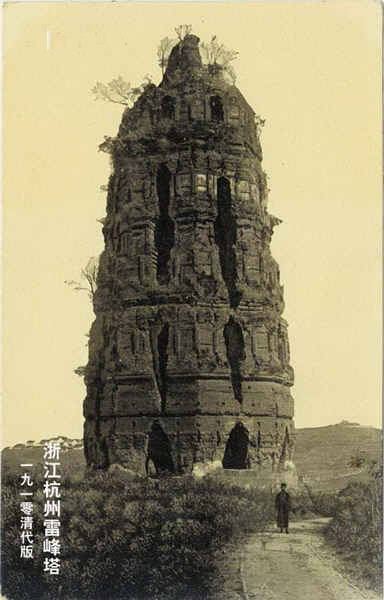
And the pagoda really fell: 1:40 in the afternoon, 25 September 1924.16 Weeks later Lu Xun asked who in the whole region 「不為白娘娘抱不平,不怪法海太多事的?」 "does not feel the injustice done to Lady White, does not blame Fahai for meddling?" His last word on the monk is 「活該。」 "Serves him right."17
So the metaphor is available. It is just not anyone else's. No named analyst calls facial recognition the new Fahai; searches in English and Chinese turned up nobody.18 The numbers do not need the loan. Amnesty International's volunteers mapped "more than 25,500 CCTV cameras across New York City."19 Georgetown Law found in 2016 that "law enforcement face recognition networks include over 117 million American adults."20 NIST measured that "across demographics, false positives rates often vary by factors of 10 to beyond 100 times."21 Fahai, at least, looked at her and saw what she was.
Notes
-
Feng Menglong 馮夢龍, "Xu" 敘 [Preface], Jingshi tongyan 警世通言, signed 「時天啟甲子臘月,豫章無礙居士題」 ("written in the twelfth month of the Tianqi jiazi year by the Layman Without Obstruction of Yuzhang"), Chinese Wikisource, https://zh.wikisource.org/wiki/警世通言/序. Tianqi jiazi is the fourth year of the Tianqi reign, 1624. Retrieved via the MediaWiki API, 16 September 2026. ↩
-
Feng Menglong 馮夢龍, "Bai Niangzi yong zhen Leifeng ta" 白娘子永鎮雷峰塔, Jingshi tongyan 警世通言, juan 28, Chinese Wikisource, https://zh.wikisource.org/wiki/警世通言/第28卷: 「小乙官人,这东西将去使用,少欠时再来取。」…「却是五十两雪花银子。」 The Wikisource source text of this chapter is stored in simplified characters; quotations follow the stored text. ↩
-
Feng, "Bai Niangzi yong zhen Leifeng ta": 「数日前邵太尉库内封记锁押俱不动,又无地穴得入,平空不见了五十锭大银。」 The sentence follows: 「配牢城营做工…牢城营乃苏州府管下」. ↩
-
Feng, "Bai Niangzi yong zhen Leifeng ta": 「你这贼贱妖精!连累得我好苦,吃了两场官事!」 The second case concerns goods missing from Zhou Jiangshi's pawnshop, for which Xu Xuan receives 「杖一百,配三百六十里,押发镇江府牢城营做工」. ↩
-
Feng, "Bai Niangzi yong zhen Leifeng ta": 「一见许宣走过,便叫侍者:『快叫那后生进来。』」 and, at the riverbank, 「业畜!在此做甚么?」…「本是妖精变妇人,西湖岸上卖娇声。汝因不识遭他计,有难湖南见老僧。」 ↩↩
-
Feng, "Bai Niangzi yong zhen Leifeng ta": 「你好大胆,又叫甚么捉蛇的来!你若和我好意,佛眼相看;若不好时,带累一城百姓受苦,都死于非命!」 ↩
-
Feng, "Bai Niangzi yong zhen Leifeng ta": 「急入寺中,问监寺道:『动问和尚,法海禅师曾来刹也未?』」…「许宣见了禅师,纳头便拜,道:『救弟子一命则个!』」…「禅师于袖中取出一个钵盂,递与许宣,道:『你若到家,不可教妇人得知,悄悄地将此物劈头一罩。』」 ↩
-
Feng, "Bai Niangzi yong zhen Leifeng ta": 「白娘子答道:『禅师,我是一条大蟒蛇,因为风雨大作,来到西湖上安身,同青青一处。不想遇着许宣,春心荡漾,按纳不住,一时冒犯天条,却不曾杀生害命,望禅师慈悲则个!』」 ↩
-
Feng, "Bai Niangzi yong zhen Leifeng ta": 「变了三尺长一条白蛇,兀自昂头看着许宣。禅师将二物置于钵盂之内…拿到雷峰寺前…砌成一塔。后来许宣化缘,砌成了七层宝塔。千年万载,白蛇和青鱼不能出世。」 ↩
-
Feng, "Bai Niangzi yong zhen Leifeng ta": 「且说禅师押镇了,留偈四句:『西湖水干,江湖不起,雷峰塔倒,白蛇出世。』」 ↩
-
Feng, "Bai Niangzi yong zhen Leifeng ta": 「奉劝世人休爱色,爱色之人被色迷。心正自然邪不扰,身端怎有恶来欺。但看许宣因爱色,带累官司惹是非。不是老僧来救护,白蛇吞了不留些。」…「惟有许宣情愿出家,礼拜禅师为师,就雷峰塔披剃为僧。」 ↩↩
-
"Xihu santa ji" 西湖三塔記, in Qingping shantang huaben 清平山堂話本, comp. Hong Pian 洪楩 (Ming), Chinese Wikisource, https://zh.wikisource.org/wiki/清平山堂話本/03: 「霎時間把刀破開肚皮,取出心肝,呈上娘娘。」…「只見卯奴變成了烏雞,婆子是個獺,白衣娘子是條白蛇。」…「奚真人化緣,造成三個石塔,鎮住三怪於湖內。」 The story sets itself 「宋孝宗淳熙年間」, in the Chunxi era of the Southern Song. ↩
-
Hsueh-Man Shen, "Between One and Many: Multiples, Multiplication and the Huayan Metaphysics," 2011 Elsley Zeitlin Lecture on Chinese Archaeology and Culture, Proceedings of the British Academy 181 (2012): 208, https://www.thebritishacademy.ac.uk/documents/1955/pba181p205.pdf: "'Qian Chu, Generalissimo of the Army of the World, King of Wuyue, has made 84,000 copies of this sutra, and interred them into the brick pagoda at the West Gate as an enduring offering. Noted on a day of the eighth month of the year of yihai [equivalent to 975].' 天下兵馬大元帥吳越國王錢俶造此經八萬四千卷入西關塼塔永充供養乙亥八月日紀." Eugene Y. Wang, "Tope and Topos: The Leifeng Pagoda and the Discourse of the Demonic," in Writing and Materiality in China (Cambridge, MA: Harvard University Asia Center, 2003), 490 and 537n11, http://www.chinaheritagequarterly.org/028/features/tope.pdf, dates the structure itself to 976: "It was built by Qian Hongchu (929-88) and his consorts in A.D. 976," and explains that "the Baoqieying jing retrieved from the pagoda is dated 975, which points to the date of the beginning of the construction." The article above therefore says "around 975" rather than naming a completion year. ↩
-
Wu Zhijing 吳之鯨, Wulin fanzhi 武林梵志 (Siku quanshu edition), juan 3, Chinese Wikisource, https://zh.wikisource.org/wiki/武林梵志_(四庫全書本)/卷03. The entry reads 「雷峯塔在淨慈寺前…錢氏妃於此建塔,故又名黄妃」 and reproduces Qian Chu's own 黄妃塔記: 「恭率珤具,創窣堵坡於西湖之滸以奉安之…宫監宏願之始,以千尺十三層為,卒爰以事力未充,姑從七級…塔曰黄妃云。吳越國王錢俶拜手謹書。」 The compiler then adds: 「俗稱塔鎮青魚白蛇,讀吳越王記,知所供惟佛螺髻髮耳。」 ↩
-
Aaron Balivet, "The Many Transformations of White Snake: Gender, Ritual, and Performance in Late Imperial China" (PhD diss., University of Wisconsin-Madison, 2020), conclusion, https://asset.library.wisc.edu/1711.dl/MKNK5FP5V6YM79E/R/file-f7383.pdf: "In nearly every version of White Snake since the late eighteenth century, White Snake is a sympathetic character." Balivet also establishes the date correction: the 1738 play is Huang Tubi's 黃圖珌, "the first extant dramatic version of White Snake," while "Fang's preface is dated to the xinmao year of the Qianlong reign, 1771, and it was printed in the following year" (n. 60). This agrees with the National Library of China's catalogue record for its copy of Leifeng ta chuanqi 雷峰塔傳奇, byline 〔清〕方成培重訂, imprint 清乾隆36年 [1771], rare-book no. 04156, reproduced at https://commons.wikimedia.org/wiki/File:NLC892-411999009460-117801_雷峰塔傳奇_第1冊.pdf. For what Fang changed, Wang, "Tope and Topos," 493: "In 1771, based on this version, Fang Chengpei readapted the tale for the theater... the son pays a visit to his entombed mother and seeks her release. The pagoda, in fact, has become a prison." Balivet notes a caveat worth carrying: Wang Shih-pe's archival work argues Fang's play had little influence on later acting scripts, and the son-and-pagoda plot predates Fang in the Chen Jiayan stage version. Tian Han's three scripts (1943, 1952, 1955) are documented in Liu Fangzheng 刘方政, 《田汉与〈白蛇传〉》, 《文艺报》, 25 October 2017, http://www.chinawriter.com.cn/n1/2017/1025/c405175-29606943.html; the 1992 serial 新白娘子傳奇 premiered on Taiwan Television, per the United Daily News preview of 4 November 1992 reproduced at https://time.udn.com/udntime/story/122834/6418978. Those last two items were fetched by a research assistant in this session and verified against the loaded pages, but I did not independently re-open them. ↩
-
Wang, "Tope and Topos," 494: "At 1:40 P.M. on September 25, 1924, the quiet of West Lake was disturbed by the sudden collapse of the Leifeng Pagoda." Confirmed independently by Hsueh-Man Shen, "Between One and Many," 205: "IN THE EARLY AFTERNOON hours of 25 September 1924, the Leifengta 雷峰塔 Pagoda located on a bluff overlooking the scenic West Lake in present-day Hangzhou collapsed." ↩
-
Lu Xun 魯迅, "Lun Leifeng ta de daodiao" 論雷峰塔的倒掉, dated 「一九二四年十月二十八日」, collected in Fen 墳, Chinese Wikisource, https://zh.wikisource.org/wiki/論雷峰塔的倒掉: 「聽說,杭州西湖上的雷峰塔倒掉了」…「可有誰不為白娘娘抱不平,不怪法海太多事的?」…「活該。」 Lu Xun names his own source for the story as the tanci 《義妖傳》, the same text illustrated in the 1869 woodblocks listed below. ↩
-
Negative finding, not a source. Searches in English and Chinese ("法海 算法 监控 隐喻 人脸识别", "'White Snake' Fahai metaphor algorithm surveillance facial recognition" and variants) returned no named analyst, scholar, journalist or published report using Fahai or the Legend of the White Snake as a metaphor for algorithms, facial recognition or content moderation. The nearest result was a hobbyist coding blog punning on the name, which is not an analyst. ↩
-
Amnesty International, "USA: Facial Recognition Technology Reinforcing Racist Stop-and-Frisk Policing in New York – New Research," news release, 15 February 2022, https://www.amnesty.org/en/latest/news/2022/02/usa-facial-recognition-technology-reinforcing-racist-stop-and-frisk-policing-in-new-york-new-research/. The same release reports that in the Bronx, Brooklyn and Queens "the higher the proportion of non-white residents, the higher the concentration of facial recognition compatible CCTV cameras." ↩
-
Clare Garvie, Alvaro Bedoya and Jonathan Frankle, The Perpetual Line-Up: Unregulated Police Face Recognition in America (Washington, DC: Center on Privacy & Technology at Georgetown Law, 2016), Executive Summary, https://www.perpetuallineup.org/. The figure is from 2016 and should be dated as such. ↩
-
Patrick Grother, Mei Ngan and Kayee Hanaoka, Face Recognition Vendor Test (FRVT) Part 3: Demographic Effects, NISTIR 8280 (Gaithersburg, MD: National Institute of Standards and Technology, December 2019), 2, https://nvlpubs.nist.gov/nistpubs/ir/2019/NIST.IR.8280.pdf. ↩
Bibliography
Amnesty International. "USA: Facial Recognition Technology Reinforcing Racist Stop-and-Frisk Policing in New York – New Research." News release, 15 February 2022. https://www.amnesty.org/en/latest/news/2022/02/usa-facial-recognition-technology-reinforcing-racist-stop-and-frisk-policing-in-new-york-new-research/.
Balivet, Aaron. "The Many Transformations of White Snake: Gender, Ritual, and Performance in Late Imperial China." PhD diss., University of Wisconsin-Madison, 2020. https://asset.library.wisc.edu/1711.dl/MKNK5FP5V6YM79E/R/file-f7383.pdf.
Feng Menglong 馮夢龍. "Bai Niangzi yong zhen Leifeng ta" 白娘子永鎮雷峰塔. Jingshi tongyan 警世通言, juan 28. Chinese Wikisource. https://zh.wikisource.org/wiki/警世通言/第28卷.
Feng Menglong 馮夢龍. "Xu" 敘 [Preface]. Jingshi tongyan 警世通言. Chinese Wikisource. https://zh.wikisource.org/wiki/警世通言/序.
Garvie, Clare, Alvaro Bedoya and Jonathan Frankle. The Perpetual Line-Up: Unregulated Police Face Recognition in America. Washington, DC: Center on Privacy & Technology at Georgetown Law, 2016. https://www.perpetuallineup.org/.
Grother, Patrick, Mei Ngan and Kayee Hanaoka. Face Recognition Vendor Test (FRVT) Part 3: Demographic Effects. NISTIR 8280. Gaithersburg, MD: National Institute of Standards and Technology, December 2019. https://nvlpubs.nist.gov/nistpubs/ir/2019/NIST.IR.8280.pdf.
Liu Fangzheng 刘方政. 《田汉与〈白蛇传〉》. 《文艺报》, 25 October 2017. http://www.chinawriter.com.cn/n1/2017/1025/c405175-29606943.html.
Lu Xun 魯迅. "Lun Leifeng ta de daodiao" 論雷峰塔的倒掉. 1924. In Fen 墳. Chinese Wikisource. https://zh.wikisource.org/wiki/論雷峰塔的倒掉.
National Library of China. Catalogue record for Leifeng ta chuanqi 雷峰塔傳奇, revised by Fang Chengpei 方成培, 清乾隆36年 [1771], rare-book no. 04156. Reproduced on Wikimedia Commons. https://commons.wikimedia.org/wiki/File:NLC892-411999009460-117801_雷峰塔傳奇_第1冊.pdf.
Shen, Hsueh-Man. "Between One and Many: Multiples, Multiplication and the Huayan Metaphysics." Proceedings of the British Academy 181 (2012): 205-58. https://www.thebritishacademy.ac.uk/documents/1955/pba181p205.pdf.
Wang, Eugene Y. "Tope and Topos: The Leifeng Pagoda and the Discourse of the Demonic." In Writing and Materiality in China, 488-552. Cambridge, MA: Harvard University Asia Center, 2003. http://www.chinaheritagequarterly.org/028/features/tope.pdf.
Wu Zhijing 吳之鯨. Wulin fanzhi 武林梵志, juan 3. Siku quanshu edition. Chinese Wikisource. https://zh.wikisource.org/wiki/武林梵志_(四庫全書本)/卷03.
"Xihu santa ji" 西湖三塔記. In Qingping shantang huaben 清平山堂話本, compiled by Hong Pian 洪楩. Chinese Wikisource. https://zh.wikisource.org/wiki/清平山堂話本/03.
Named but not consulted
Feng Menglong. Stories to Caution the World: A Ming Dynasty Collection, Volume 2. Translated by Shuhui Yang and Yunqin Yang. Seattle: University of Washington Press, 2005. Story 28. The publisher's page was fetched and confirms the edition, the translators and the September 2005 date, but the translation itself was not consulted; all English renderings above are my own from the Wikisource Chinese.
Fang Chengpei 方成培. Leifeng ta chuanqi 雷峰塔傳奇, 1771. Only the National Library of China's catalogue record and scholarly descriptions of the play were consulted. Its text was not read.
Idema, Wilt L. The White Snake and Her Son. Indianapolis: Hackett, 2009. Cited here only at second hand, through Balivet's references. No part of the book itself was loadable.
Lai, Whalen. "From Folklore to Literate Theater: Unpacking 'Madame White Snake.'" Asian Folklore Studies 51, no. 1 (1992): 51-66. The full text was loaded by a research assistant in this session, but it names neither Feng Menglong, 1624, Huang Tubi, Fang Chengpei nor the Leifeng Pagoda, so nothing in this article rests on it.
UNESCO World Heritage listing for West Lake; Zhejiang Provincial Museum; the official Leifeng Pagoda site. All three were attempted for the pagoda's history. UNESCO returned HTTP 403 and the other two did not resolve, so none is cited.
Image credits
Flooding the mountain, woodblock print from Yiyao zhuan, 1869. Public domain.
The white snake reveals itself, woodblock illustration in Feng Menglong, Jingshi tongyan, 1624. Public domain.
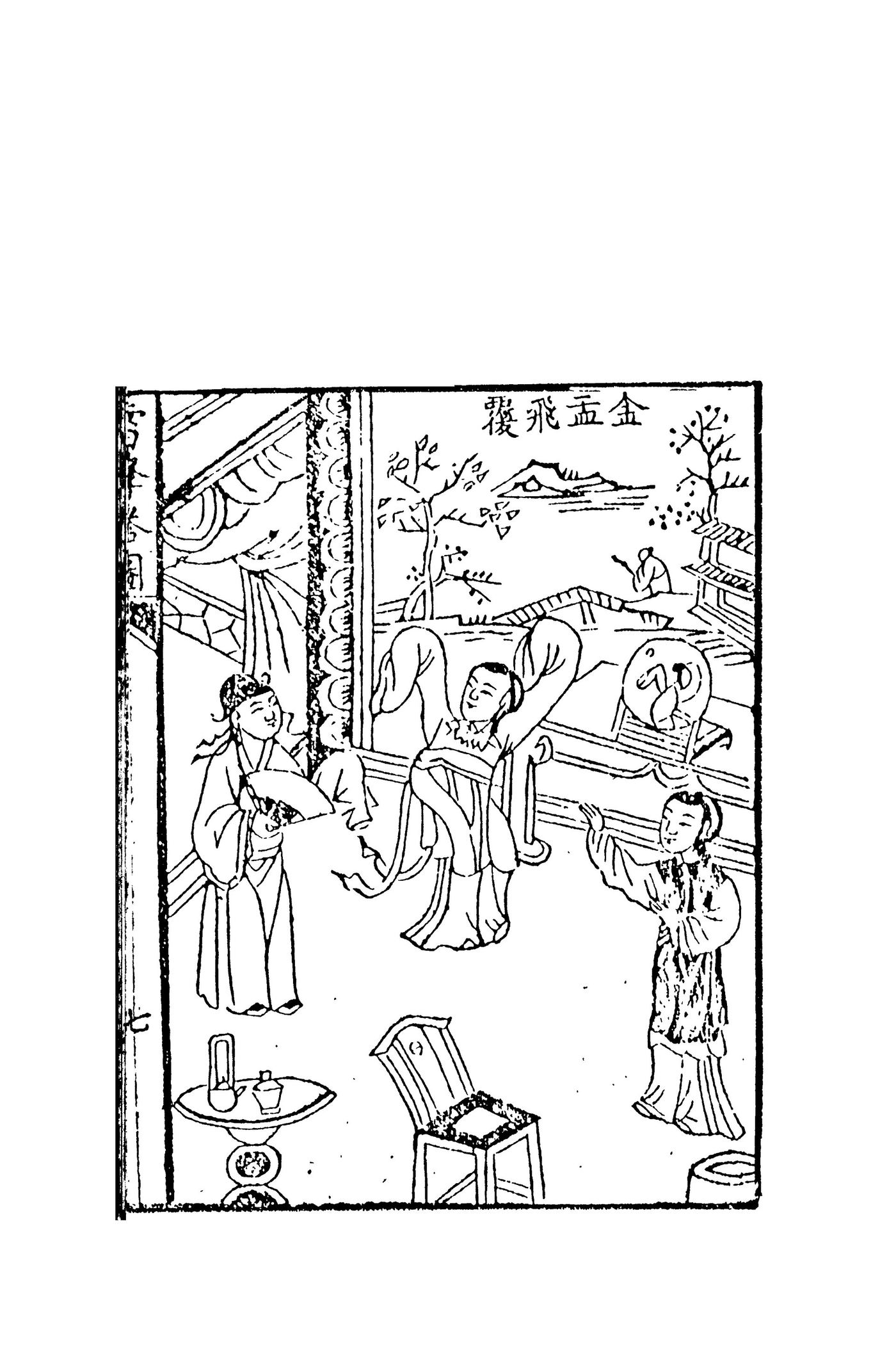
The golden bowl descends, woodblock print, 1806. Public domain.
Leifeng Pagoda, Hangzhou, photographed in 1910, fourteen years before it collapsed. Public domain.